ATE test development for production silicon
I'm Daniel Walsh, a principal test development engineer based in Dublin. For fifteen years I have taken devices from first silicon to high-volume production for the world's leading semiconductor companies. I work with test teams that need an experienced engineer for a test program, a load board, a characterisation campaign or a yield problem.
Email daniel@dwsemitest.com See the services
- Experience
- 15 years in ATE test development
- Primary platform
- Teradyne IG-XL and VBT
- Devices
- Mixed-signal, RF and power
- Location
- Dublin, Ireland. Remote, and on site worldwide
Services
I work on my own or as part of your test team, on the scope you do not have the headcount for. The work is handed back documented and correlated, so your team owns it afterwards.
- Test program development
- Production test programs on Teradyne IG-XL and VBT, and on other platforms: written, debugged, correlated and documented for handover.
- Silicon bring-up and debug
- First silicon on the tester, including pattern debug, datalog triage and failure analysis with the design team.
- DIB and load board hardware
- Specification and review of load boards, DIBs and probe cards, covering signal integrity, power delivery, sockets and contact strategy.
- Characterisation and validation
- Shmoo, corner and temperature characterisation, datasheet correlation, and limits set from measured distributions.
- Mixed-signal, RF and power
- Test methods for ADCs and DACs, PLLs, SerDes, RF front ends and high-current power devices.
- Yield and cost of test
- Test-time reduction, multisite scaling, insertion merges and limit rationalisation, with coverage maintained.
- Production release and OSAT transfer
- Release packages, gauge studies, tester-to-tester correlation and transfer into your subcontractor's flow.
- Consulting and training
- Test strategy reviews, DFT feedback, methodology audits and hands-on training for in-house test teams.
Platforms and tools
Most of my work is on Teradyne testers with IG-XL and VBT, where I have written, debugged and released production programs from start to finish. I have also worked on the other major ATE platforms, so a port or a second-source evaluation is familiar work.
A growing share of the job is software: Python and VB.NET tooling around the test program, STDF and datalog processing, automated correlation reports, and analysis of lot data to support limit decisions. I also build and use AI tools for test engineering, and ATE·IQ came out of that work.
| Platform or tool | Level | Typical work |
|---|---|---|
| Teradyne IG-XL and VBT | Primary platform | Full program ownership, release to high-volume production |
| Other major ATE platforms | Hands-on | Ports, evaluations, debug support |
| Bench correlation | Primary | ATE-to-bench matching, datasheet limits |
| Probers and handlers | Hands-on | Setup, contact yield, throughput |
| Python | Primary language | Datalog parsing, automation, analysis |
| VBA and VB.NET | Primary language | IG-XL VBT test methods and tooling |
| C and C++ | Hands-on | Test methods, DLLs, instrument drivers |
| Data and scripting | Hands-on | STDF and ATDF processing, SQL, Perl, shell, Git |
| AI tools | Primary | LLM agents and coding assistants for test program generation, code review and lot data analysis, on Anthropic, OpenAI-compatible and Azure OpenAI models |
How an engagement works
-
Scoping call
We talk through the device, the tester, the insertion, the timeline and what finished looks like. Thirty minutes, free of charge, under NDA if you need one.
-
Written scope and quote
Within two to three days you receive the deliverables, the assumptions, what I need from your side, and a day rate or a fixed price.
-
Execution
I work in your revision control and your release process, and send a short weekly status you can forward to management.
-
Handover
You receive the documented program, the correlation data and a walkthrough with your team. Nothing depends on me afterwards.
ATE·IQ
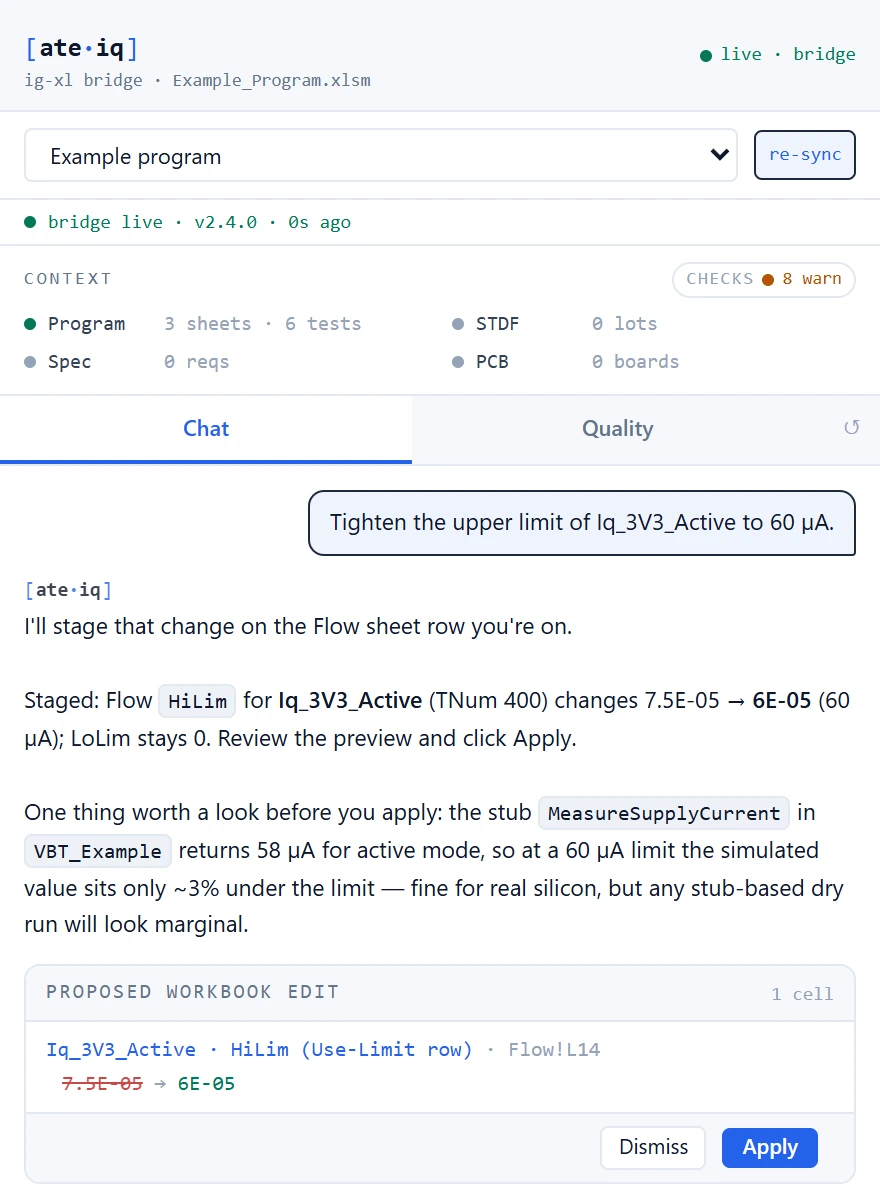
ATE·IQ is the software product I develop alongside consulting work. It writes an IG-XL test program from a device spec, including the sheets, the VBT code and the digital patterns, and checks the program before you open it. An assistant then works beside Excel in the program you have open: it explains tests, proposes edits and applies them when you approve.
ATE·IQ also reads load board exports from your EDA tool and STDF data from production, so the spec, the program, the board and the test results can be checked against each other. It runs on your own workstation, with the LLM provider your organisation already uses.
About
D.W. Semiconductor Test Ltd is an independent consultancy founded in Dublin in 2021 by Daniel Walsh. My background is fifteen years of ATE test development on mixed-signal, RF and power devices, from characterisation to high-volume production release.
The engineer who scopes the work is the engineer who does it. I work remotely from Dublin by default and travel for bring-up, debug and production transfer. I am used to working under NDA and inside a client's existing revision control and release process.
Contact
Send the device type, the tester and your timeline, and I will reply with scope and availability.